
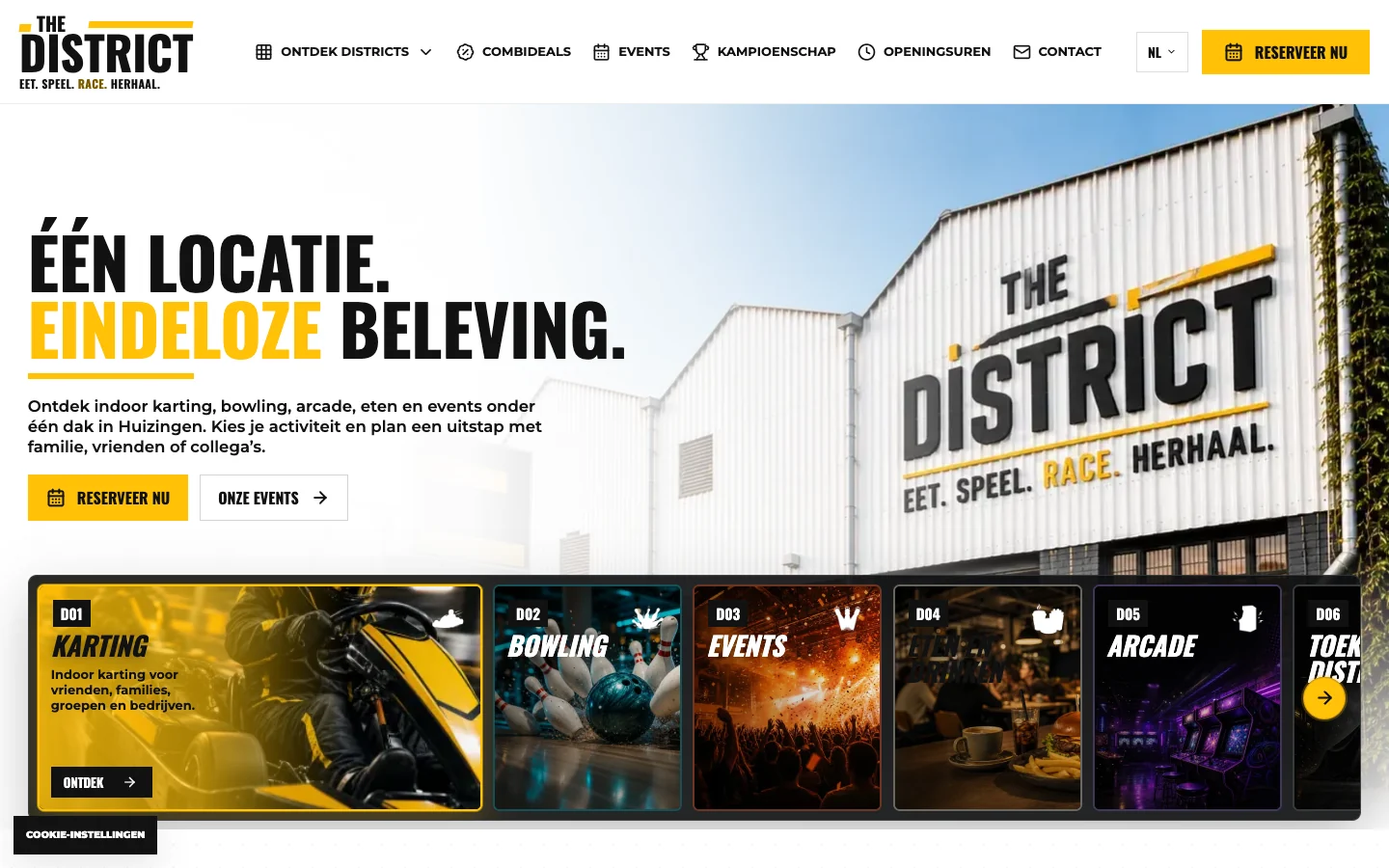
The design decision in one paragraph
The most important design decision for The District was not a colour or animation. It was deciding how four different activities could remain distinctive without making the website feel like four unrelated brands. The solution became one stable information system with a different visual energy for each activity.
The question behind the screen
The District combines karting, bowling, karaoke and events in one venue. Visitors rarely arrive looking for “the full offer”, however. They want a specific activity, a group formula or practical information that helps them decide.
The website therefore had to do two things at once:
- express the shared atmosphere and scale of The District;
- guide each visitor quickly towards the relevant activity and booking route.
Decision framework
| Question | Decision | Reason |
|---|---|---|
| How does each activity stay recognisable? | A distinct accent colour and image rhythm | Faster scanning without building four separate sites |
| What remains consistent? | Stable patterns for practical information and actions | Visitors do not have to relearn the interface |
| Where does booking appear? | Close to the relevant activity and information | The next step remains clear in context |
| How does it work on mobile? | Reorder content rather than merely shrinking it | Small screens require different priorities |
One system, not a uniform template
Consistency does not mean every page should look identical. Navigation, typography, information logic and action patterns form the system. Colour, photography and composition give each activity its own character.
That distinction also makes the site maintainable. New campaigns or activities can use recognisable building blocks without requiring a fresh interface every time.
What we deliberately do not claim
The case documents qualitative outcomes: a recognisable digital experience, faster orientation and a foundation that can grow. Without validated before-and-after analytics, we do not invent a booking or conversion increase. An honest case explains what was designed and why.
What JF-ICT handled in this engagement
JF-ICT brought content structure, UX, visual design and responsive delivery together. The technical foundation accounted for performance, clear HTML and routes both people and search engines can follow.
Ongoing marketing campaigns or SEO growth targets were not automatically part of the website build. The project did create a foundation The District can continue to communicate and expand from.
View the full The District case study with desktop, tablet and mobile imagery, or explore JF-ICT’s SME website approach.